Introduction
Rice is one of those foods that sits at the center of so many daily meals across so many different cultures that getting it right consistently matters more than most people realize. A perfectly cooked pot of rice — fluffy, evenly cooked, neither mushy nor dry — elevates everything it accompanies. A poorly cooked one can quietly drag down an otherwise well-prepared meal. And yet, despite how frequently most households cook rice, achieving that consistency on a stovetop remains surprisingly elusive for a large number of home cooks.
Electric rice cookers have addressed this problem for decades. But the category has evolved considerably beyond the simple mechanical switch models that dominated kitchen counters for years. Modern rice cookers — particularly those using fuzzy logic technology — are more accurately described as intelligent grain and meal cookers that happen to excel at rice. They make micro-adjustments during the cooking process, accommodate a wide range of grains and cooking styles, and offer functionality that extends well beyond the single task their name implies.
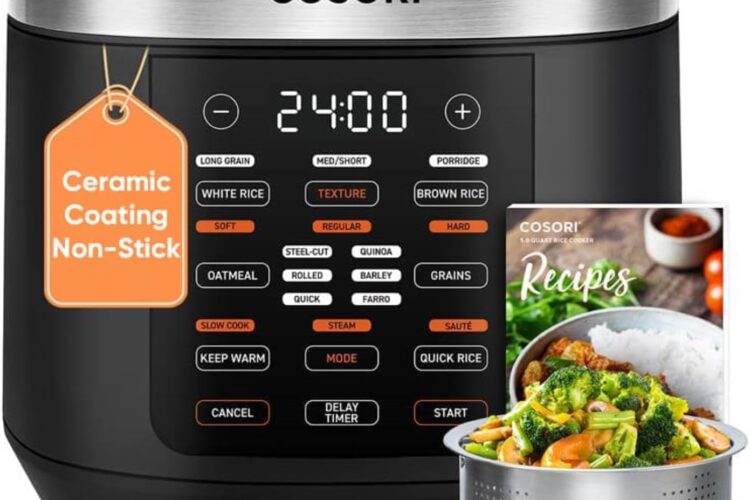
The COSORI Rice Cooker 10-Cup sits firmly in this advanced category. With 18 cooking functions, a non-stick ceramic inner pot, fuzzy logic programming, a 24-hour keep-warm feature, and a stainless steel steamer basket, it represents a meaningful step up from basic rice cookers — and a genuine alternative to more expensive Japanese-made models that have traditionally defined the premium end of this appliance category.
This article takes a thorough, honest look at what the COSORI 10-Cup offers, how it performs across different cooking tasks, who is likely to get the most value from it, and what to think carefully about before deciding whether it belongs in your kitchen.
What Is the COSORI 10-Cup Rice Cooker?
The COSORI 10-Cup is a digitally controlled, fuzzy logic rice cooker and multicooker designed for home use. Its 10-cup capacity refers to uncooked rice — which yields approximately 20 cups of cooked rice — making it suitable for medium to large households, regular meal prep, or anyone who cooks rice in significant quantities.
COSORI is a brand that has built a strong presence in the small kitchen appliance market over the past several years, becoming particularly well known for its air fryers before expanding into a broader range of cooking tools. The rice cooker reflects that same design philosophy: thoughtfully featured, competitively positioned, and aimed at home cooks who want more capability than a basic appliance offers without paying premium prices.
The defining technical feature of this model is its fuzzy logic programming — a form of artificial intelligence that monitors cooking conditions in real time and makes subtle adjustments to temperature and timing to optimize results. This is what separates it from simpler digital models that follow a fixed program regardless of what’s actually happening inside the pot.
Key Features of the COSORI 10-Cup Rice Cooker
Fuzzy Logic Technology
Fuzzy logic is a term that gets used frequently in the rice cooker world, and it’s worth understanding what it actually means before assessing its value. Unlike a basic rice cooker that applies heat according to a fixed schedule, a fuzzy logic cooker uses sensors to continuously monitor the internal temperature of the pot and makes real-time adjustments to the cooking process based on what it detects.
In practical terms, this means the cooker can compensate for variables that would otherwise affect results — the temperature of the water when cooking begins, the specific variety of rice being used, how tightly the grains are packed in the measuring cup, and even ambient conditions in the kitchen. The result is more consistent output across a wider range of conditions than fixed-program cookers can achieve.
For everyday white rice, the difference may be subtle. For brown rice, mixed grains, and other more demanding cooking tasks, fuzzy logic tends to produce noticeably more reliable results.
18 Cooking Functions
Eighteen distinct cooking settings is a substantial number, and it reflects the ambition of this appliance to function as a genuine multicooker rather than a dedicated rice machine. The functions typically include settings for white rice, brown rice, sushi rice, mixed rice, quick cook, porridge, congee, oatmeal, soup, steam, slow cook, sauté, and various grain-specific modes.
Each setting is calibrated differently — adjusted cooking time, temperature curve, and pressure management — to suit the characteristics of the food being prepared. This matters because brown rice, for instance, has a much harder bran layer than white rice and requires both more water and longer cooking time to become properly tender. A dedicated brown rice setting accounts for those differences automatically, without requiring the user to manually adjust anything.
The breadth of functions does mean there is an initial learning period as you discover which setting works best for different dishes, but the included documentation and COSORI’s online resources help flatten that curve considerably.
Non-Stick Ceramic Inner Pot
The inner cooking pot of the COSORI 10-Cup is made from ceramic-coated material rather than the standard non-stick coatings found in many competing models. This is a meaningful distinction for several reasons.
Ceramic coatings are generally considered a cleaner, more inert option compared to traditional PTFE-based non-stick coatings. They don’t release fumes when heated, are more resistant to scratching under normal use conditions, and tend to be easier to clean because food releases readily from the surface without requiring aggressive scrubbing. The ceramic surface also distributes heat somewhat differently than metal, contributing to even cooking across the bottom and sides of the pot.
It’s worth noting that ceramic coatings, like all non-stick surfaces, do require some care. Metal utensils should be avoided inside the pot, and abrasive cleaning tools can damage the surface over time. Treating it with reasonable care extends its useful life significantly.
10-Cup Capacity
Ten cups of uncooked rice producing roughly 20 cups of cooked rice positions this appliance in the larger end of the home rice cooker spectrum. This capacity serves medium to large families comfortably and makes the appliance particularly useful for batch cooking — preparing a large quantity of grains on the weekend to carry through the week.
For smaller households of one to three people, 10 cups may feel like more than necessary for daily use. The cooker functions perfectly well with smaller quantities, but it’s worth considering whether the physical footprint of a 10-cup model is justified by your typical cooking volumes.
24-Hour Keep Warm Function
The keep-warm function on the COSORI maintains cooked food at a safe, consistent serving temperature for up to 24 hours after cooking completes. This is a significantly longer window than the keep-warm functions on most basic rice cookers, which typically maintain temperature for a few hours before being switched off.
For households where meals are eaten at irregular times — or where rice is used as an ingredient across multiple meals throughout the day — this extended warm-holding capability adds genuine practical value. Rice that has been kept warm properly remains safe to eat and reasonably pleasant in texture, though as with any cooked food, quality does gradually diminish over extended holding periods.
Stainless Steel Steamer Basket
The included stainless steel steamer basket sits above the cooking pot and allows vegetables, fish, dumplings, and other steam-friendly foods to cook simultaneously while the rice or grains prepare below. Stainless steel is a particularly good material choice for a steamer basket — it doesn’t react with food, doesn’t absorb odors, and holds up well to repeated use and dishwasher cleaning.
The simultaneous steaming capability is one of the more practical features from a meal preparation standpoint. Being able to produce rice and a steamed vegetable side dish at the same time using a single appliance reduces both active cooking time and the number of pots and pans required.
Sauté Function
The sauté function allows the inner pot to be heated directly at a higher temperature than the cooking functions use, enabling browning of aromatics, toasting of spices, or reduction of sauces within the same vessel. This is the feature that most clearly positions the COSORI as a multicooker rather than a rice cooker with a few extras.
Being able to sauté onions and garlic in the pot before adding rice and liquid to cook means that pilaf-style rice dishes, risotto-adjacent preparations, and grain dishes with built-in flavor development can all be prepared entirely within the appliance without transferring ingredients to a separate pan.
Slow Cook Function
The slow cook setting applies low, extended heat in a manner similar to a dedicated slow cooker. Soups, stews, braises, and other long-cook dishes can be prepared using this function, which expands the COSORI’s utility well beyond grain cooking. For households that want slow cooker functionality without owning a separate appliance, this setting offers a reasonable alternative for most slow cooker recipes.
Delay Timer
A programmable delay timer allows the cooker to be loaded with ingredients and set to begin cooking at a future time — useful for preparing rice to be ready when you return home, or for scheduling morning oatmeal to be warm and ready when you wake up. This feature adds meaningful convenience for anyone who plans meals in advance rather than cooking reactively.
How the COSORI 10-Cup Can Be Used
Everyday White Rice
This is the baseline function and the one most households will use most frequently. The white rice setting on the COSORI, enhanced by fuzzy logic monitoring, produces consistently fluffy, well-separated grains without requiring any manual intervention. Rinse the rice, add the appropriate amount of water using the inner pot’s measurement lines, select the white rice setting, and let the cooker handle the rest.
The fuzzy logic element is particularly valuable here because white rice is deceptively variable — long grain behaves differently from short grain, jasmine has different moisture requirements than basmati, and aged rice absorbs water differently from freshly milled rice. The monitoring system compensates for these differences more effectively than a fixed timer can.
Brown Rice and Whole Grain Cooking
Brown rice requires roughly 1.5 times the water and significantly more cooking time than white rice. On a stovetop, this translates to 45 or more minutes of simmering with careful attention to prevent scorching. The COSORI’s dedicated brown rice setting manages this automatically, including adjustments to the temperature curve that prevent the bottom layer of rice from overcooking while the top finishes.
The same principle applies to other whole grains — farro, barley, wheat berries, millet, and quinoa all have distinct cooking requirements that the COSORI’s grain-specific settings or adjustable programs can accommodate without manual calculation.
Sushi and Japanese-Style Rice
Sushi rice requires a specific texture — slightly sticky, with enough moisture to hold together when shaped — that differs meaningfully from standard steamed rice. The COSORI includes a dedicated sushi rice setting calibrated for short-grain Japanese rice varieties, producing results that support sushi rolling, onigiri making, and Japanese rice bowl preparations.
Congee and Rice Porridge
Congee — a rice porridge made by cooking rice in a large volume of water or broth until it breaks down into a thick, creamy consistency — is a staple breakfast and comfort food across much of East and Southeast Asia. It requires extended cooking and significantly more liquid than standard rice, and the COSORI’s porridge or congee setting handles both requirements automatically. The result is a smooth, properly textured congee without the monitoring that stovetop preparation demands.
Steaming Vegetables and Proteins
With the stainless steel steamer basket positioned above the cooking pot, vegetables and proteins can be steamed while rice cooks below. Broccoli, green beans, asparagus, bok choy, fish fillets, and shrimp are all foods that steam efficiently and pair naturally with the rice being prepared simultaneously. This simultaneous cooking approach — a complete grain and vegetable component of a meal produced in one appliance at the same time — is one of the more time-efficient meal preparation techniques available with this cooker.
Slow-Cooked Soups and Stews
Using the slow cook function, the COSORI can prepare a wide range of soups, stews, and braises over an extended low-heat period. Lentil soup, chicken and vegetable stew, bean-based dishes, and similar long-cook preparations translate well to this setting. The appliance won’t replicate every nuance of a dedicated slow cooker — particularly those with oval inserts designed for whole roasts — but for liquid-based dishes and stews, it performs the function competently.
Sautéed and Pilaf-Style Rice Dishes
The sauté function enables a style of rice preparation that basic cookers cannot achieve. Toasting dry rice in a small amount of oil before adding liquid is the foundation of rice pilaf — a technique that produces a nuttier flavor and more distinct, separated grains than standard steamed rice. With sauté capability built in, this technique becomes accessible directly in the COSORI without transferring to a skillet.
Similarly, the ability to soften onions and garlic, bloom spices, or brown aromatics before switching to a cooking mode allows for more flavor-forward rice and grain dishes than a standard rice cooker can produce.
Oatmeal and Hot Cereals
The porridge and slow cook functions make the COSORI useful for morning oatmeal, particularly steel-cut oats that benefit from longer cooking times. Using the delay timer, steel-cut oats can be loaded the night before and set to finish cooking at a specific morning time, producing a warm, ready breakfast without any morning effort beyond serving.
Who the COSORI 10-Cup May Be Suitable For
Medium to Large Families
The 10-cup uncooked capacity comfortably produces enough rice for six to eight people as a substantial side dish, or four to six people as a meal component with other dishes. For families who eat rice multiple times per week, the capacity and consistency of this cooker make it a natural fit.
Serious Home Cooks Who Cook Multiple Grain Types
Households that regularly move between white rice, brown rice, quinoa, oatmeal, and other grains will find the COSORI’s dedicated settings for different grain types genuinely useful. Rather than adapting a general cooking setting to each grain, having calibrated programs for different types produces more reliable results with less adjustment.
Meal Prep Enthusiasts
The 10-cup capacity, the 24-hour keep-warm function, and the simultaneous steaming capability all make the COSORI particularly appealing to people who batch-cook for the week. A large pot of brown rice or mixed grains alongside steamed vegetables, prepared in a single session, provides the foundation for multiple weekday meals.
Households Interested in Reducing Appliance Count
With 18 functions covering rice cooking, steaming, slow cooking, sautéing, porridge making, and more, the COSORI can reasonably replace several single-purpose appliances. For households trying to consolidate their kitchen equipment while maintaining broad cooking capability, this appliance is worth serious consideration.
People Cooking Asian Rice Dishes Regularly
The inclusion of settings specifically calibrated for sushi rice, mixed rice, congee, and other preparations common in East and Southeast Asian cooking makes the COSORI particularly relevant for households whose daily cooking draws heavily from these traditions. The fuzzy logic system’s ability to fine-tune results for short-grain and glutinous rice varieties is especially valuable here.
Home Cooks Upgrading from a Basic Rice Cooker
For someone who has been using a simple on/off mechanical rice cooker and wants noticeably better results — particularly with brown rice or specialty grains — the COSORI represents a significant capability upgrade at a price point that remains accessible relative to premium Japanese brands.
Important Things to Consider
Physical Size and Counter Space
A 10-cup rice cooker is a substantial appliance. It’s larger and heavier than smaller models, and it requires meaningful counter or cabinet space. Before purchasing, it’s worth measuring your available space and assessing whether the 10-cup capacity is genuinely necessary for your household’s typical cooking volumes. If you regularly cook for two people, a 5 or 6-cup model might serve your needs with a smaller footprint.
Ceramic Pot Care Requirements
While the ceramic inner pot offers real advantages in terms of cleanliness and surface safety, it does require some care to maintain. Metal utensils should not be used inside the pot — silicone or wooden tools are appropriate. The pot should be allowed to cool before washing, and abrasive scrubbing pads should be avoided. Following these guidelines keeps the ceramic coating in good condition for extended use.
Initial Learning Period
Eighteen functions is genuinely useful, but it also means there’s more to learn before getting comfortable with the appliance. New users may find the first few weeks involve some experimentation — learning which setting works best for their preferred rice variety and texture, how the delay timer interacts with different recipes, and how the slow cook function compares to their existing slow cooker habits. This learning curve is normal for any capable multicooker, but it’s worth factoring in as a realistic expectation.
The Distinction Between Fuzzy Logic and Induction Heating
Premium Japanese rice cookers from brands like Zojirushi and Tiger often use induction heating — a technology that heats the entire pot from the sides and bottom simultaneously for even more precise temperature control. The COSORI uses fuzzy logic with conventional heating, which is a meaningful step up from basic digital models but a different approach from induction-based cookers. For most home cooks, fuzzy logic produces excellent results. For those who have used high-end induction cookers and are comparing directly, the distinction is worth understanding.
Water Ratios and Measurement
The inner pot has measurement lines for both rice and water, but the ratios can take some getting used to — particularly for users transitioning from stovetop cooking, where different ratios are used, or from cooking different rice varieties that have varying water absorption characteristics. Following the included guide closely during the first several uses and making small adjustments based on results is the most reliable way to dial in your preferred outcome.
Slow Cook Function Limitations
While the slow cook setting works well for soups and liquid-based stews, it has natural limitations compared to a dedicated slow cooker. The round pot shape and smaller volume compared to a 6 or 7-quart oval slow cooker mean that very large cuts of meat — a whole pork shoulder or a large beef roast — won’t fit. For those specific applications, a dedicated slow cooker remains the more appropriate tool.
How the COSORI 10-Cup Compares to Other Cooking Approaches
Basic Mechanical Rice Cookers
The simplest rice cookers use a mechanical switch that flips from cook to warm when the internal temperature reaches a fixed point. They handle white rice adequately and are inexpensive and reliable. The COSORI’s fuzzy logic system, multiple grain settings, and expanded cooking functions represent a substantial capability improvement — particularly for brown rice, specialty grains, and any cooking function beyond basic white rice boiling.
Basic Digital Rice Cookers
One step up from mechanical models, basic digital rice cookers have a few preset programs and a digital timer but lack fuzzy logic monitoring. They follow fixed programs regardless of what’s happening inside the pot. The COSORI’s real-time adjustment capability produces more consistent results, especially across different rice varieties and varying water temperatures.
Premium Japanese Rice Cookers
Brands like Zojirushi and Tiger represent the premium end of the rice cooker market, often using induction heating, multiple pressure settings, and highly refined fuzzy logic systems developed over decades. These appliances typically produce outstanding rice quality and carry price tags that reflect their engineering. The COSORI offers a meaningful portion of that capability at a considerably lower price point — an appealing trade-off for home cooks who want above-average rice quality without premium appliance pricing.
Instant Pot and Electric Pressure Cookers
The Instant Pot and similar multicookers overlap with the COSORI in several function areas — both can cook rice, steam vegetables, and prepare soups and stews. The key difference is cooking method: the Instant Pot uses pressure to dramatically shorten cooking time, while the COSORI uses conventional steam and heat optimized by fuzzy logic. For rice specifically, many users find that a dedicated rice cooker produces superior texture to pressure-cooked rice, which can sometimes turn out slightly gummier than ideal. For applications where speed is the priority, the Instant Pot has an advantage; for rice quality and grain-cooking precision, a dedicated fuzzy logic cooker generally wins.
Stovetop Rice Cooking
Stovetop rice cooking offers the most direct control and requires no dedicated appliance. For experienced cooks who cook the same rice variety consistently, stovetop results can be excellent. The trade-off is active attention and the variability that comes with manual timing and heat adjustment. The COSORI removes that variability and the need for monitoring, which is its primary advantage over the stovetop approach.
Frequently Asked Questions
What does fuzzy logic actually do differently from a standard digital rice cooker?
A standard digital rice cooker follows a fixed cooking program regardless of conditions — it applies heat for a set duration and then switches to warm. Fuzzy logic adds real-time monitoring through temperature sensors. The cooker detects what’s happening inside the pot and makes micro-adjustments to temperature and timing throughout the cooking process. This produces more consistent results across different rice varieties, water temperatures, and batch sizes than a fixed program can achieve.
Can I cook less than a full 10-cup batch?
Yes. The COSORI works with smaller quantities, and most of its settings function well with two to three cups of uncooked rice. For very small batches — one cup or less — results may be slightly less consistent than with larger quantities, but the appliance handles reduced volumes without difficulty.
How does the ceramic pot differ from standard non-stick coatings?
Traditional non-stick coatings are typically made from PTFE (commonly known by the brand name Teflon). Ceramic coatings are made from inorganic mineral compounds and are generally considered a cleaner option that doesn’t release fumes when heated and doesn’t contain PTFE or PFOA. Both surfaces are non-stick in practical terms, but ceramic is typically considered more food-safe at high temperatures and more environmentally friendly in its production.
Is the steamer basket large enough to steam a complete side dish?
The stainless steel steamer basket is sized appropriately for a side-dish portion of vegetables or a small quantity of protein. For a family of four, it can handle a meaningful serving of broccoli, carrots, or similar vegetables simultaneously with the rice below. For very large quantities of steamed food, additional steaming in a separate appliance might be needed.
How long does brown rice take in the COSORI?
Brown rice typically takes between 50 and 70 minutes in the COSORI, depending on the quantity and the specific variety. This is longer than white rice, which averages 25 to 35 minutes, but significantly less hands-on than stovetop brown rice preparation requiring constant monitoring.
Does the keep-warm function dry out rice over time?
All keep-warm functions will gradually affect rice texture over time. For the first few hours, properly kept rice remains quite good. Over longer periods — approaching the 24-hour maximum — the outermost rice grains may become slightly firmer or drier. Adding a small amount of water before engaging the keep-warm function, or stirring the rice occasionally, can help maintain quality over extended periods.
Can I use the COSORI to make risotto?
Risotto traditionally requires constant stirring as liquid is added incrementally — a technique that isn’t directly replicable in a rice cooker. However, the sauté function combined with the white rice or slow cook setting can produce a risotto-style dish if the recipe is adapted. It won’t be identical to traditionally stirred risotto, but the result is a creamy, flavorful rice dish that many households find satisfying.
Is the inner pot removable for serving?
Yes. The ceramic inner pot lifts out of the base unit and can be brought directly to the table for serving, which reduces the need for additional serving bowls and simplifies the process of getting food from the cooker to the plate.
Conclusion
The COSORI Rice Cooker 10-Cup represents a thoughtfully designed appliance that sits in a genuinely useful middle ground — more capable and consistent than basic digital rice cookers, more accessible in price than premium Japanese induction models, and more versatile than any single-function grain cooker. Its fuzzy logic programming, ceramic inner pot, 18 cooking functions, and extended keep-warm capability combine to form an appliance that can credibly serve as a central tool in a wide range of home kitchens.
Its value is clearest for households that eat rice and grains frequently, cook for larger groups, engage in regular meal prep, or want to consolidate kitchen equipment without sacrificing cooking capability. The 10-cup capacity makes it particularly well-suited to medium and large families, while the breadth of functions rewards users who are willing to explore beyond the basic rice setting.
For anyone who has been frustrated by inconsistent stovetop rice or who has been using a basic single-function rice cooker and wants meaningfully better results across a wider range of ingredients, the COSORI 10-Cup is a serious and capable upgrade worth exploring.